
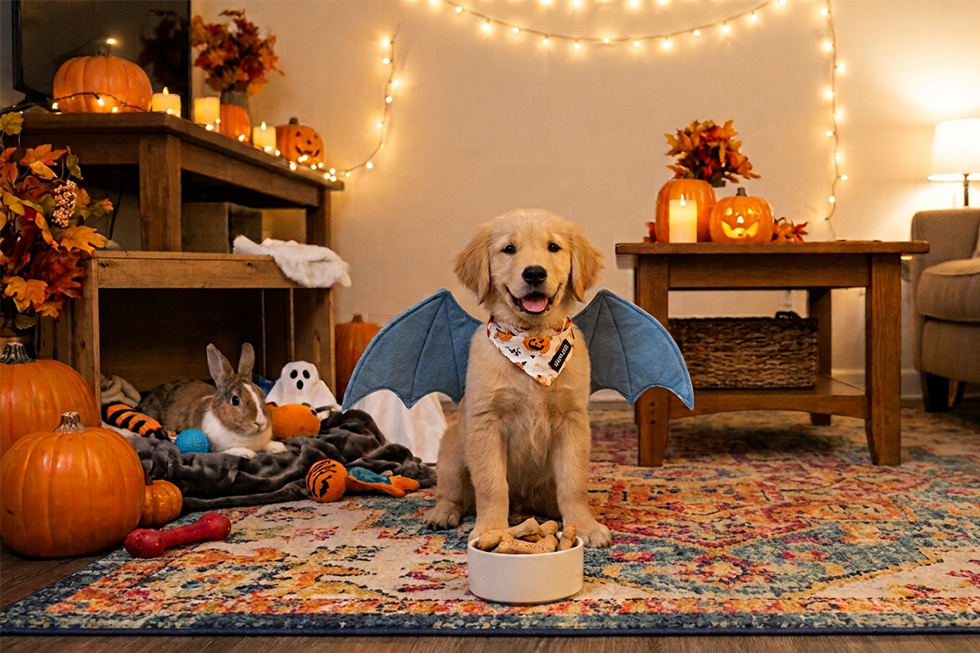
Halloween brings risks to pets this time of year, chocolate and other toxic candy, the doorbell going non-stop, and general stress from strangers in and out. Here is what to watch for and what to do if something goes wrong.
Chocolate is the number one Halloween emergency
A common emergency call we get around Halloween is chocolate ingestion. Dogs are especially at risk because they can’t resist chocolate. Chocolate contains theobromine, which dogs and cats can’t process the way people can.
The rough rule: darker chocolate is more dangerous. Baking chocolate and dark chocolate are much worse than milk chocolate, and white chocolate has very little theobromine. Small dogs are at greater risk from smaller amounts.
Signs of chocolate poisoning usually show up within six to twelve hours: vomiting, diarrhea, restlessness, an unusually fast heart rate, muscle tremors, and in severe cases seizures.
What to do if your pet ate chocolate: call us during business hours at (706) 387-0006, or the ASPCA Animal Poison Control Center at (888) 426-4435. Have this information ready: how much your pet weighs, what kind of chocolate and roughly how much, and when they ate it. Do not wait to see if symptoms show up.
Watch for xylitol too
Xylitol is a sugar substitute found in some sugar-free candies, gum, and even peanut butter. It is far more toxic to dogs than chocolate: it causes a rapid, dangerous drop in blood sugar and can cause liver failure. Check ingredient labels on anything labeled “sugar-free” and keep it out of reach.
The doorbell problem
For most dogs, a doorbell that rings every few minutes for hours is genuinely stressful. Combine that with strangers in costumes, excited shouts, and the door constantly opening, and even calm pets can bolt or become reactive.
Some things that help:
- Set up a safe room away from the front door with their bed, water, and a comforting toy. Turn on a TV or music to soften the sound.
- Keep them on a leash or behind a gate if they are in the same room as the front door, secure them with a leash or gate off the door area.
- Feed them earlier than usual and give them something to work on (a chew, a food puzzle) during the busiest trick-or-treat hours.
- Make sure their microchip and ID tags are up to date in case they do get out.
Decorations to watch
Real candles inside pumpkins are a tail-wag or curious-cat away from a fire or a burn. Consider battery-operated candles.
When to call
If your pet ate something they shouldn’t have, or is showing any of the signs above, call us at (706) 387-0006 during our regular hours. For after-hours emergencies, call your nearest emergency veterinary clinic right away.
Have a safe Halloween, and enjoy the holiday.
About the Author
Name: Dr. Tyler Poole, DVM
Role: Veterinarian, Galilee Veterinary Hospital
Credential: Doctor of Veterinary Medicine (DVM)
Employer: Galilee Veterinary Hospital
School: University of Georgia
Short Bio: Tyler Poole, DVM, was raised in the town of Cornelia, Georgia. He received his Bachelor of Science in Biology from the University of Georgia. He graduated with his doctorate in Veterinary Medicine from the University of Georgia in 2018.